Gunnera Passage
A visit to Trebah during summer would not be complete without experiencing the green twilight world of the Gunnera Passage
The Gunnera Plantation at Trebah is one of the most dramatic and memorable features of the valley.
Gunnera × cryptica’s stalks can grow to 3m in height and its leaves up to 2m in diameter by early summer, creating a striking, almost prehistoric atmosphere within the garden.
This remarkable plant is renowned for its extraordinary speed of growth, emerging in early spring and reaching full scale by June. It towers over everyone, and no summer visit to Trebah is complete without walking beneath its gigantic leaves; experiencing one of the largest foliage displays in the country.
Spring
As temperatures rise, Gunnera bursts into life. Large, crinkled leaves unfurl from the crown, accompanied by central flower spikes.
Summer
The plantation reaches its full height and scale. The leaves create a dense canopy and lots of shade, offering shelter from both sun and rain.
Autumn
Leaves begin to collapse, helped along by the wind. The gardeners cut the stems and place the leaves over the crown, more for visual appeal than protection.
Winter
The plant dies back into dormancy, creating a ghoulish appearance in the plantation over winter. If it’s mild, new leaves may begin to appear early.
Botanical background
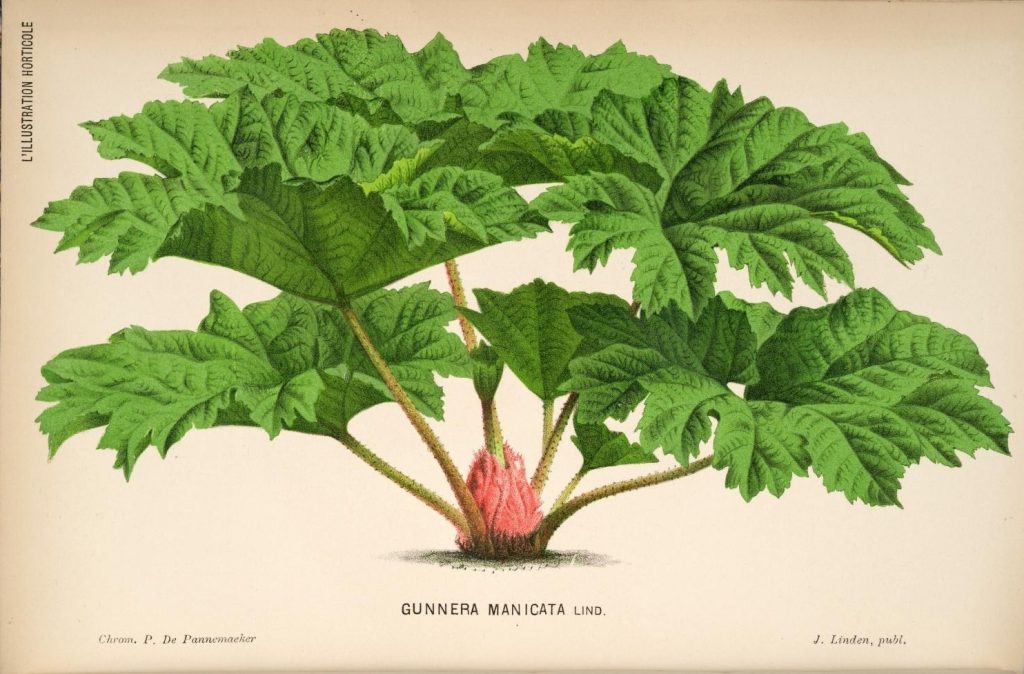
Gunnera is commonly known as giant rhubarb because of its similar appearance to the edible vegetable, though they aren’t botanically related. It is native to South America, and the stalks of various species are eaten in some countries.
It was named after a Norwegian botanist and bishop, Johann Ernst Gunnerus.
For many years, the gunnera at Trebah was believed to be Gunnera manicata. However, recent botanical research has shown that true Gunnera manicata is likely to be absent from UK cultivation, and that the plants grown in the UK are in fact a hybrid, now named Gunnera × cryptica.
This is a cross between Gunnera manicata and Gunnera tinctoria. In 2023, G. tinctoria was classed as invasive in the UK, so the sale and propagation of this plant is restricted. Thankfully, established plantings such as those at Trebah can continue to be carefully managed.
Gunnera needs moist, fertile soil to reach its incredible size.
A living history
This Gunnera Plantation was established at Trebah in the 1950s, alongside the development of the neighbouring Hydrangea Valley, to provide bold structure and scale within the garden. In 1986, the Hibbert family cut a path through the plantation, allowing visitors to walk beneath the leaves and experience the plants up close.
However, we recently found that gunnera was present in the garden much earlier than originally thought.
In 2025, an album of photographs titled Memories of Trebah, captured during a holiday in the 1920 or 1930s, revealed stunning images of enormous gunnera leaves (below).
This suggests that gunnera may have been present at Trebah since the late 19th century; introduced during the ownership of the Fox or Backhouse families.


Management & care
Despite its size, gunnera is relatively straightforward to manage at Trebah. It is naturally-irrigated by the spring-fed stream that runs through the valley, so only requires watering in exceptionally dry summers.
The garden team carefully manages our gunnera to prevent spread beyond the garden, ensuring it remains a spectacular part of the landscape.


